
Every week I find fascinating emails flood my inbox with studies on all things mind—consciousness, morality, free will, belief, perception, and so forth. Now I’d like to start sharing some of them.
Below are a selection of interesting studies and papers I’ve gathered from the last couple of weeks. I intend to make this a regular newsletter, so if you enjoy this type of thing as much as I do, hit subscribe.
A Science of Consciousness
Consciousness is a notoriously difficult thing to study. One of the more prominent theories floating about today is Integrated Information theory (IIT), an approach which relies on phenomenology to determine the essential features of consciousness, and then asks what properties a physical system like the brain must have for these features to be present.
IIT has come under fire, with a group of over 100 academics labelling it as pseudo-science, claiming that it’s untestable in principle, and has counterintuitive and non-empirical consequences. There have been two responses to this assertion, one from Tononi et al, and another from Alex Gomez-Marin and Anil Seth.
Gomez-Marin and Seth defend the scientific status of IIT, while not necessarily endorsing it. Many theories become testable long after they’re first formulated, it’s too early to go ruling out theories of consciousness.
“Good theories often behave like organisms; they grow, develop, mutate, and learn from mistakes. One must not forget that any scientific theory is inherently provisional. Absolute certainty is the absolute enemy of scientific inquiry.”
They point out that both Einstein’s theory of relativity and astrology had groups of academics attempting to refuse their entry into the scientific lexicon. Carl Sagan was invited to sign the letter against astrology, but he refused, not because he thought astrology had any validity, but because the approach was too authoritarian.
Gomez-Marin and Seth concur:
“The take-home message: be it relativity or astrology, trial by authority is antithetical to science.”
The Influence of Intensive Meditation on Belief in Free Will
While a lot of research has explored the cognitive and mental health benefits of meditation, this preprint from Sabugo et al. (pdf) examined how experience in meditation influences higher-order beliefs in free will.
First, experienced meditators were initially less likely to believe in free will. Then, two groups were assigned to take part in an 8-week meditation retreat, or a podcast group that had access to the same audio content but could be listened to at home. The group on the retreat showed a decrease in free will belief while the podcast group showed no change.
Why might this happen? Intensive meditation likely increases our awareness of how thoughts arise spontaneously, thus weakening the perception of conscious control. Many people also experience a reduction in a sense of self that might contribute.
“Just as one may experience a lack of choice in the moment of perceiving a sound, its volume, or its duration—meditators may come to perceive that they do not choose thoughts, the moment of their occurrence, their content, how they persist, or the emotional impact they carry.”
Lay Theories of Moral Progress
While some past research suggests most people see morality as declining, of those who believe that the world is getting morally better, what do they see as the mechanism behind this progression?
Casey Lewry, Sana Asifriyaz, and Tania Lombrozo distinguish between the belief that moral progress is driven either by human actions, or through an inherent societal trajectory or natural force.
People who believe human actions produce moral improvement are more likely to feel personal intervention was necessary to correct moral setbacks, and indicated greater willingness to donate.
“Together these studies suggest that beliefs about the mechanisms of moral progress have important implications for engaging in social action.“
Evidence for Multiple Kinds of Belief in Theory of Mind
In another paper from Tania Lombrozo, this time with Alejandro Vesga and Neil Van Leeuwen, a distinction is made between epistemic beliefs—which aim to track the truth—and non-epistemic beliefs, which serve other functions like social identity, emotional comfort, or moral conviction.
Epistemic beliefs are more likely to be framed in probabilistic terms (e.g., “There’s an 80% chance this is true”), are more open to evidence-based revision, and often expressed using the verb “think”. In contrast, non-epistemic beliefs tend to be binary (“I believe this, period”), resistant to change, and play a stronger role in identity and group cohesion.
“Our findings call for a more fine-grained characterization of theory of mind and provide indirect support for the hypothesis that human cognition itself features multiple varieties of belief.”
People Think Women Are Morally Superior to Men
This paper by Jordan Wylie et al. found that women are consistently judged to be morally superior to men.
They tested this in a few different ways—when people imagined the face of a morally good person, they pictured a female face; people were more likely to ascribe morally good traits to women than men; they also found that behaviours associated with moral goodness are typically stereotyped as feminine.
However, it also turned out that women were judged more harshly for moral indiscretions:
“[W]e find that immoral behavior is more diagnostic for women than men. As a result, equivalent moral transgressions lead to larger negative character updating for women than for men.”
Beyond Imitation Games
Inês Hipólito, Mahault Albarracin, and Jacqueline B. Hynes (pdf), attempt an empirical and falsifiable foundation for studying consciousness, which is aimed at addressing the limitations in computational models of consciousness.
If the mind is computational and AI systems are computational, we must accept that either AI systems are conscious, that there are unknown computational features that cause consciousness, or that the computational theory is wrong.
Instead, their framework shifts the focus from computational complexity to observable patterns of organisation in biological and synthetic systems. They suggest that minimal sentience can be defined through three necessary and jointly sufficient conditions: Active Self-Maintenance, Historical Adaptability and Autonomous Agency.
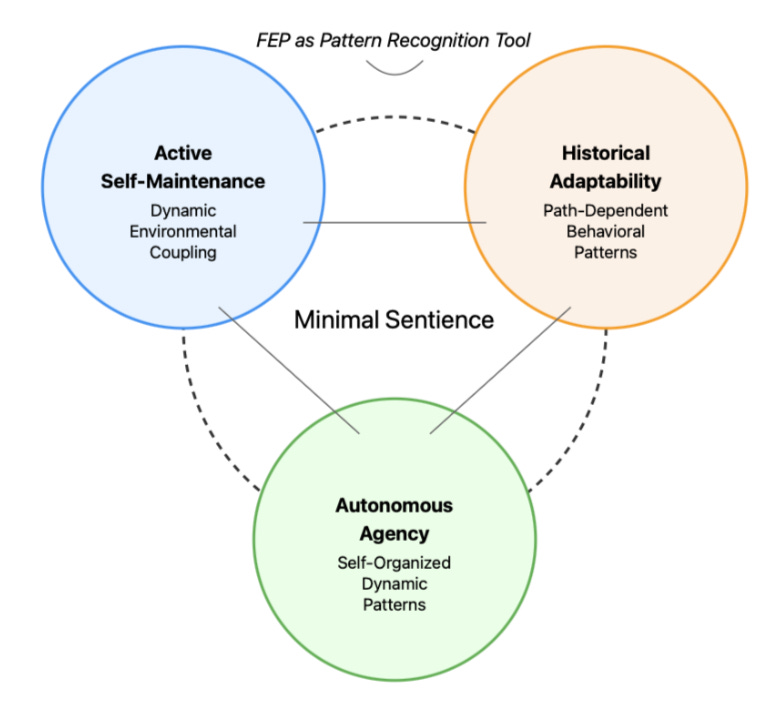
“[T]he Emergent Sentient Framework serves as a tool for clarity and systematizing research in philosophy of mind and consciousness sciences. It highlights the relationships and distinctions between natural, artificial, and hybrid systems, offering a structured pathway for interdisciplinary exploration.”
That’s it for now, but sign up to our newsletter to stay tuned for more:

