
Welcome to your dispatch of new scientific papers, articles, and ideas helping to uncover the workings of that all-important organ between your ears.
Recently, in the science of mind, we find you’re still to blame when you’re willfully ignorant of the consequences of your actions; your brain has distinct neural algorithms for “things” and “stuff”; and that we don’t like sharing our good deeds, but still want people to find out anyway. Plus more.
All the details below:
A Framework for Blaming Willful Ignorance
When someone’s actions cause harm, the level of blame they get depends on the level of understanding they had. If they knew they would do harm, they are more to blame than if they we unaware.
But, what if they willfully ignore information about the consequences of their actions? In this case, the level of blame is somewhere in between—they’re more to blame than an ‘accidentally’ ignorant person, but less to blame than someone who acted in full knowledge.
The authors of this study looked into how our perceptions of blame are shaped in the cases of willful ignorance, and propose a framework highlighting three considerations:
- Epistemic inferences: People assume that if someone avoids information, they probably already suspected something bad, so they “knew enough” to be blameworthy.
- Counterfactual inferences: People think willfully ignorant agents wouldn’t have acted differently even if they had known, which makes them look more culpable.
- Personality inferences: Avoiding knowledge signals selfish or antisocial motives, which increases blame.
People see willful ignorance not just as a lack of knowledge, but as a morally loaded choice that reveals something about character, motives, and responsibility.
“Willfully ignorant agents who could have become informed but chose not to, receive more blame than unintentionally ignorant agents.”
‘World Models’ Mount a Comeback
Inside your brain is a simplified model of the world, a predictive map of your environment and the laws governing it. This helps you make your way around around the house or the city streets safely and efficiently, it also gives you a space to run experiments—to imagine what would happen if you did this or that.
For a while, computers were thought to need these models. Then they were pushed aside. Now they may be on their way back. The big question is whether world models can emerge from the deep learning methods in vogue today, or if AI is in need of a more explicit codification.
“Instead of world models, today’s generative AIs appear to learn “bags of heuristics”: scores of disconnected rules of thumb that can approximate responses to specific scenarios, but don’t cohere into a consistent whole. (Some may actually contradict each other.)”
Your Brain on “Things” and “Stuff”
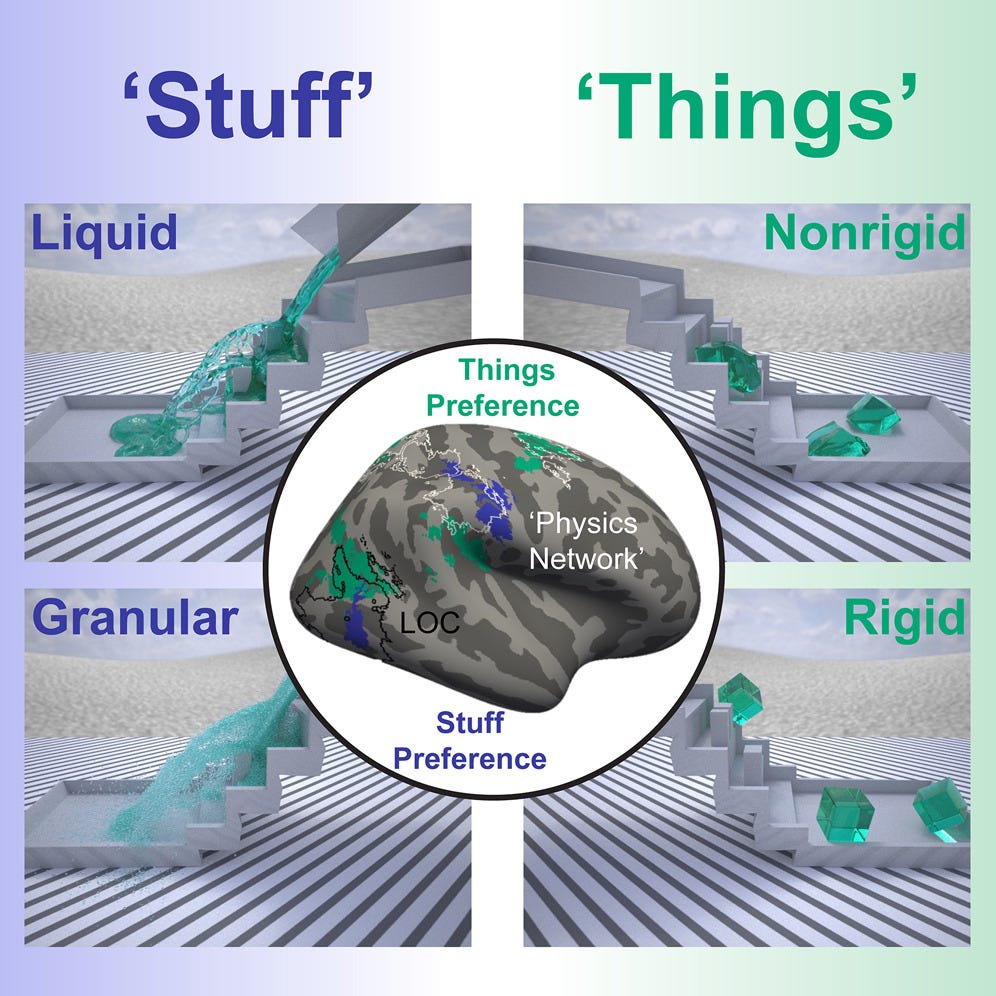
They’re words we often use when we don’t actually know what we’re referring to, yet we do know something about the nature of their being: we say “stuff” when we’re talking about something continuous and uncountable, while “things” are discrete and can be counted.
This study identified different brain networks that help us distinguish between things and stuff, showing how our mind carves the world into objects and substances.
“We find double dissociations between the processing of things and stuff within both the ventral and dorsal visual pathways. These findings suggest that distinct mental algorithms are engaged when we perceive things and stuff, as they are in artificial physics engines.”
Mapping Domains of Life Success
Life success can mean many different things—money, health, happiness, relationships, growth.
In this huge meta-analysis (it’s more meta-meta-analysis), the researchers find that the Big 5 personality traits (neuroticism, agreeableness, conscientiousness, extraversion, openness) are quite predictive of success, and that their different combinations predict success in different domains, eg: Conscientiousness is ideal for achievement at work and school.
They also find three large ‘metaclusters’ of domains of life success: Contentment, Agentic Engagement, and Self-Transcendence.
“We suggest that these 10 life success clusters represent archetypal life success goals and their associated personality profiles reflect archetypal means for realizing these diverse ends.”
The Do-Gooder Dilemma
This study finds that people generally think that sharing stories of their own good deeds will leave them feeling worse off, particularly if they share it on social media.
Perhaps we don’t like sharing our good deeds because that would make it look as though we did it out of self-interest, to better our reputation, than out of pure altruism. It’s also possible we don’t want to come across as though we’re admonishing others for not behaving in a similar way.
Interestingly, despite our reluctance to sharing our own good deeds, we think that when others share stories of their good deeds, they’ll feel better for it.
“[I]ndividuals who commit good deeds may face a “do-gooder dilemma”—wanting the benefits of having their good deeds known, but not wanting to incur the costs of announcing them. As Oscar Wilde wrote, ‘The nicest feeling in the world is to do a good deed anonymously—and have somebody find out.’”
Studying Philosophy Can Make You A Better Thinker
Study (open access) | article in The Conversation
Philosophy majors tend to perform better on a number of tests, and are generally more open-minded and reflective. But, does studying philosophy make someone this way? Or does the subject attract those who already exhibit these characteristics?
This study, which relied on tests and surveys from over 600,000 students and looked at differences between students both before and after studying varying degrees, found that philosophy does indeed make for certain improvements.
“[P]hilosophy majors scored higher than students in all other majors on standardized tests of verbal and logical reasoning, as well as on self-reports of good habits of mind, even after accounting for freshman-year differences. This suggests that their intellectual abilities and traits are due, in part, to what they learned in college.”
The authors note that one likely reason for this is that philosophy is not a body of knowledge in the way other fields are, rather it’s an activity that relies on deep, critical thinking and constant questioning. These results aren’t surprising then, given what philosophy is, but it’s good to have empirical support.
“Philosophy is not a theory but an activity.” —Ludwig Wittgenstein

