What’s New in the Science of Mind?
The mind remains one of science’s final frontiers—complex, unpredictable, and deeply personal. Every few weeks, I gather what’s new, strange, and significant from the expanding edges of neuroscience, psychology, and philosophy.
If you’re drawn to questions about consciousness, free will, and what it means to be a mind, stick around. Subscribe to get the next dispatch straight to your inbox.
These are the latest studies and ideas that stood out:
Adult Brains Create New Neurons
Science Paper (Paywall) | Science commentary
Most of the cells in your body will be replaced over your lifetime, but neurons are not like most cells. You brain will have more neurons just after you’re born, than at any other point in your life. From then, neurons are trimmed away, with more refined networks being left behind.
It’s been an open question for many years whether the adult brain still produces any new neurons—called neurogenesis. Santiago Ramón y Cajal, one of the early pioneers of neuroscience, claimed brain cells are “fixed, ended, and immutable”.
However, a growing range of studies now suggest that adult brains can in fact produce new neurons, specifically in the hippocampus.
This latest study used machine learning to identify the gene activity of neural progenitor cells, and then found these same signatures within postmortem brain tissue.
The rate of growth is still much lower than in early life, and there was a large degree of variation among adults—some people showed no evidence of these progenitors. This suggests that neuronal growth is reliant on other environmental and biological factors.
Core Systems of Music Perception
Link (paywall) | Full Preprint
Samuel Mehr writes that there are two universal systems of musical perception that form the foundation for human musicality:
- Tonal, which deals with pitch and establishes a hierarchy of tones.
- Metrical, which deals with the temporal domain and creates a hierarchy of rhythmic groupings.
“That the two key principles of music perception reviewed here appear to be so pervasive in our species — and not other species — raises the possibility that our auditory system is designed by natural selection to decode song and other forms of music into hierarchically structured tonal and metrical information, in a fashion that is distinct from the mechanisms of audition that are specialized for speech.”
How Smell Guides Our Inner world
When it comes to studying perception, smell gets a backseat to other senses like vision and hearing. Part of the problem has been the lingering belief that people are bad smellers—Paul Broca called humans ‘anosmatique’, meaning “non-smellers”, while Freud claimed smell was just a primitive sense.
Yet, we all know that specific smells are capable of conjuring distant memories. Much of what we call taste involves smell. And it is our most ancient sense (making Freud somewhat correct), with chemical interactions informing the basic organisms of our evolutionary past about the world around them.
“We don’t know exactly how chemicals translate to perception,” says Valentina Parma. This is beginning to change, with a number of researchers taking aim at an understanding of olfaction. The first myth we need to bust is that of people being bad smellers, and we need a vocabulary for describing smells. The new datasets and studies are helping push the science of smell forward.
“The brain is organized around the sense of smell […] In the very beginning is breathing, and then comes smell with breathing, and then comes the rest of the brain.” —Thomas Hummel
Machine Bullshit
Researchers from Princeton and UC Berkeley are tackling the nonsense AI can produce. They start with a ‘bullshit index’ for quantifying the algorithms’ indifference to truth, and define four categories to assign the bullshit to:
- Empty Rhetoric: flowery language with no substance
- Paltering: vague qualifiers that dodge firm statements
- Weasel Words: partial truths intended to mislead
- Unverified Claims: assertions without evidence or credible support
Upon testing 2,400 scenarios and 100 AI assistants, they find that:
“model fine-tuning with reinforcement learning from human feedback (RLHF) significantly exacerbates bullshit
and
inference-time chain-of-thought (CoT) prompting notably amplifies specific bullshit forms, particularly empty rhetoric and paltering.”
and
“We also observe prevalent machine bullshit in political contexts, with weasel words as the dominant strategy.”
Modelling Human Cognition
Marcel Binz et al. introduce a system called ‘Centaur’ “that can predict and simulate human behaviour in any experiment expressible in natural language.”
Centaur was trained on Psych-101 database, which includes over 60,000 participants across 160 experiments, and involving 10,000,000+ choices. It could then predict human behaviour in novel experiments, and even modelled human neural activity.
Centaur could help with the design and interpretation of new experiments, or offer insights into how people process information and develop internal representations.
However, there has also been some pushback to just how accurate and generalisable this model is: “I think there’s going to be a big portion of the scientific community that will view this paper very skeptically and be very harsh on it,” says Blake Richards.
The Evolutionary Foundations of Moral Blame
We evolved to err on the side of caution. It is better to wrongly think there’s a predator (false positive) than to mistakenly ignore a real one (false negative)—to be safe than sorry.
Biases and errors in judgement that are less costly to survival and reproduction will be favoured over time. This can be seen in our attributions of blame and harmful intent—it is better to blame an innocent person than to miss someone dangerous.
Nassim Elimari, Cory Clark, Jean Decety, and Gilles Lafargue, find evidence for this bias in brain scans:
“[T]he brain perceives failure to detect harmful agents as a more serious error than falsely attributing malice.”
It seems over-blaming is an evolutionary adaptation. It is interesting that we’ve built judicial systems that generally lean in the other direction—to be innocent until proven guilty. See Blackstone’s Ratio: “Better that ten guilty persons escape than that one innocent suffer.”
Is there any tension between these legal systems and our evolutionary biases?
Cognitive Chicanery
When confronted with inconvenient facts and counter arguments, the human mind picks from a wealth of mental tools to help it avoid any uncomfortable conclusions. These ‘belief-system defenses’ can make morally wrong claims look like they’re empirically wrong.
In a study of over 7,000 participants across 5 experiments, Cory Clark et al. find many examples of this ‘cognitive chicanery’, grouping them into 5 categories:
- Confusion: Dismissing claims because they’re not understood.
- Postmodernism: claiming that science can’t answer such questions.
- CIA’s Simple Sabotage Field Manual: nitpicking over words and details.
- Schopenhauer’s Art of Always Being Right Stratagems: There are 38 of them, everything from ad hominem arguments to begging the question and appealing to authority.
- Contradictory arguments: endorsing two contradictory claims, ie: this is preposterous! | This is old news!
“All strategies were activated at once, in a sort of “belief-system overkill,” that ensures avoidance of unfortunate epistemic discoveries.”
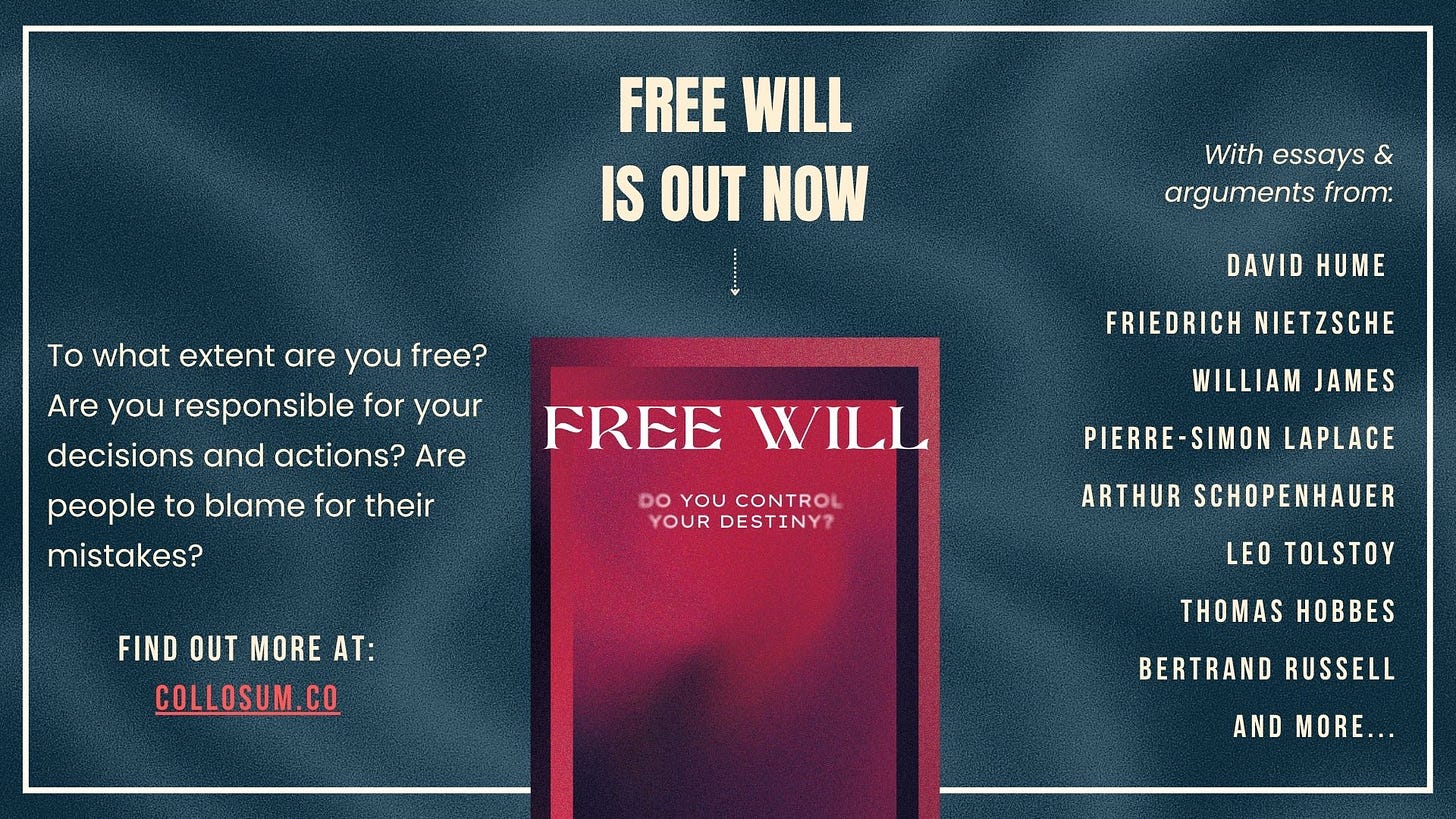
GET YOUR COPY OF FREE WILL
The questions don’t stop here. Explore how thinkers across time have wrestled with freedom, agency, and control in Free Will—the first book in the Collosum collection. It’s available now, and makes a great companion to the themes explored here.